
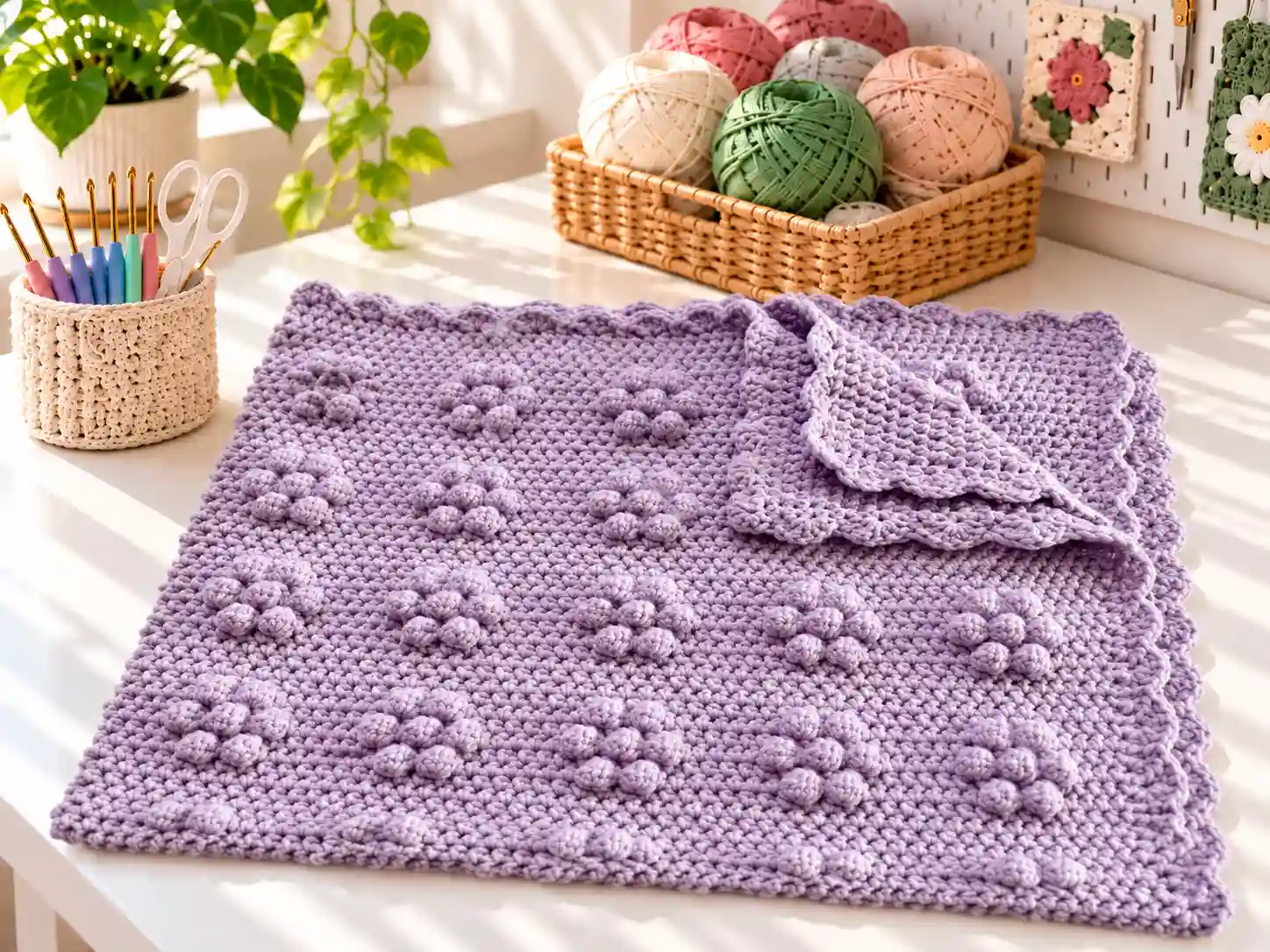
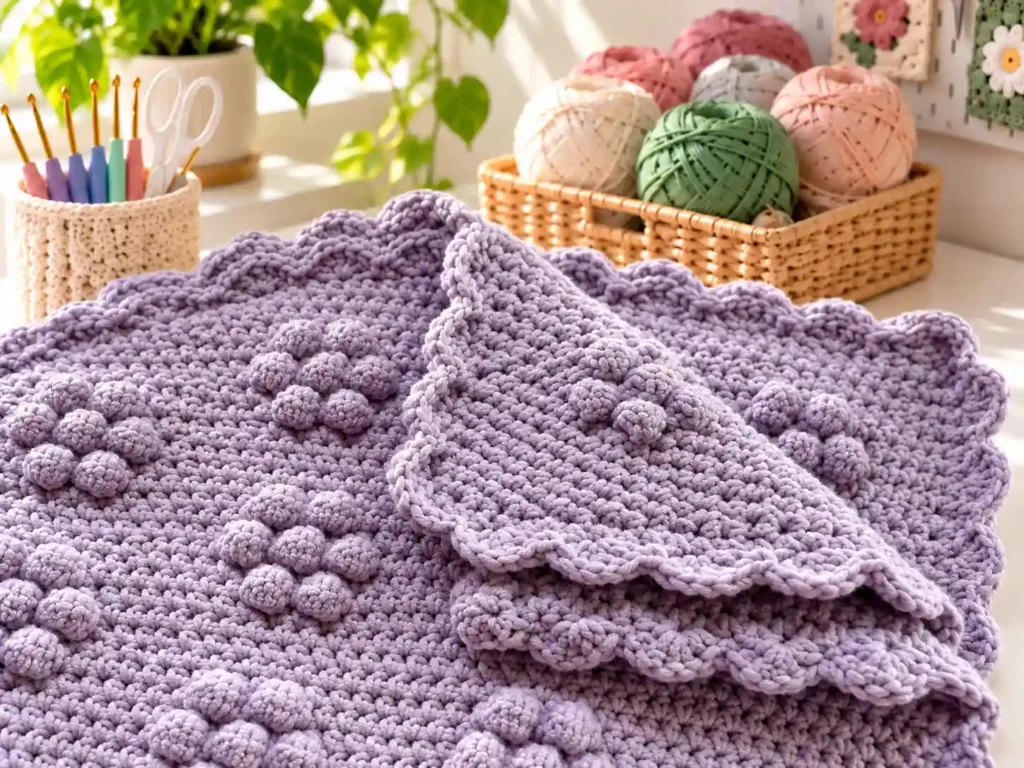
The Crochet Daisy Rows Baby Blanket is a soft, textured baby blanket with little bobble flowers scattered across gentle rows of wide half double crochet. The flowers are worked directly into the fabric, so there are no separate motifs to sew together, and the simple two-round border gives the finished blanket a tidy, polished edge.
It is a lovely choice for a baby girl crochet blanket, a nursery gift, or a stroller-size throw. The repeating flower rows are easy to follow once you understand the bobble stitch, and the plush chenille-style yarn makes the finished fabric feel especially cozy.
Why You’ll Love This Crochet Project
- The daisy flowers are formed with bobble stitches, so they stand out beautifully from the background fabric.
- The blanket is worked in straightforward rows, making it a good beginner baby blanket crochet pattern once the bobble technique is learned.
- The pattern repeat is easy to adjust if you want a wider or longer blanket.
- A single colour keeps the design clean and modern, while the texture provides all the visual interest.
- It makes a thoughtful handmade baby shower gift.
Finished Size
The finished blanket measures approximately 37 inches by 37 inches. The stated gauge is 4 inches = 12 stitches and 12.5 rows of pattern.
Your final size may vary slightly with yarn substitution, hook size, and personal tension. Making a small swatch before starting is the best way to check that your fabric has the drape and flower definition you want.
Materials You’ll Need
- Bernat Future Hope yarn, 100% recycled polyester, 170 g / 6 oz, 305 m / 333 yds per skein: 4 skeins in Mauve Over
- Size I / 5.5 mm crochet hook
- Tapestry needle
- Scissors
Yarn Information
Bernat Future Hope is a #4 worsted-weight chenille yarn made from recycled polyester. It has a plush, velvety feel and creates a soft fabric with excellent stitch definition for the bobble flowers.
Four skeins are used for the listed size. If you substitute another worsted or chunky baby blanket crochet yarn, choose one with a similar thickness and softness. A smoother worsted-weight acrylic or cotton blend will also work, though the flowers may look slightly less plush.
Chenille yarns can sometimes split or shed fibers while you work. Pulling from the outside of the skein, rather than the center, can help reduce tangling.
Crochet Hook
This pattern uses a 5.5 mm / US size I-9 hook. The yarn label recommends a 5.0 mm hook, but the slightly larger hook gives the blanket more drape. If your bobble stitches look loose or do not pop forward enough, try the 5.0 mm hook instead.
Crochet Abbreviations
This pattern uses US crochet terminology.
- ch = chain
- sc = single crochet
- hdc = half double crochet
- dc = double crochet
- whdc = wide half double crochet
- dc5tog = double crochet 5 together bobble
- sl st = slip stitch
- st(s) = stitch(es)
- yo = yarn over
Special Stitches
Wide Half Double Crochet (whdc): Yarn over, insert your hook between the stitch posts rather than under the top loops, yarn over and pull up a loop, then yarn over and pull through all three loops on the hook.
Double Crochet 5 Together Bobble (dc5tog): Yarn over, insert your hook into the indicated space, yarn over and pull up a loop, then yarn over and pull through two loops. Repeat this four more times in the same space, leaving five unworked loops on the hook after the final partial double crochet. Yarn over and pull through all six loops on the hook to close the bobble.
Pattern Notes
- The blanket is worked flat in rows using US terms.
- The foundation chain has 127 chains. The flower pattern repeat is a multiple of 5, plus 2.
- At the end of each row, chain 2 and turn.
- The wide half double crochet is worked between stitch posts, creating a soft, slightly open fabric.
- The daisy flowers appear in alternating bobble rows.
- Repeat Rows 6 through 15 until the blanket reaches your preferred length.
- Do not fasten off after the final body row; you will continue directly into the border.
Crochet Daisy Rows Baby Blanket Pattern
Part 1: Blanket Body
Foundation: Chain 127.
Row 1: Starting in the third chain from the hook, work 1 hdc in each chain across. Ch 2 and turn.
Rows 2 to 5: Work 1 whdc in each space across. Be sure to work into the final space between the last stitch and the turning chain. Ch 2 and turn.
Row 6: Work 1 whdc in each of the first 6 spaces. Work 1 dc5tog bobble in the next space, 1 whdc in the next space, then 1 dc5tog bobble in the next space. Work 1 whdc in each of the next 7 spaces. Repeat from across, ending with 1 whdc in each of the last 6 spaces. Ch 2 and turn.
Row 7: Work 1 whdc in each space across. Ch 2 and turn.
Row 8: Work 1 whdc in each of the first 5 spaces. Work 1 dc5tog bobble in the next space, 1 whdc in the next space, 1 dc5tog bobble in the next space, 1 whdc in the next space, and 1 dc5tog bobble in the next space. Work 1 whdc in each of the next 5 spaces. Repeat from across. Ch 2 and turn.
Row 9: Work 1 whdc in each space across. Ch 2 and turn.
Row 10: Repeat Row 6.
Rows 11 to 15: Work 1 whdc in each space across. Ch 2 and turn.
Continue: Repeat Rows 6 through 15 until you have 10 sets of flower rows, or until the blanket reaches your desired length.

Part 2: Border
At the end of the last body row, chain 1 to begin working down the side of the blanket.
Round 1: Work 1 round of sc around the entire blanket. Work 1 sc per row along the sides and 1 sc per stitch across each end, continuing to insert the hook between the stitch posts. Work 3 sc in each corner space.
Round 2: At the starting corner, sl st to the starting stitch and ch 1. Continuing in the same direction, work 1 sc into the next stitch. Skip 1 stitch, work 5 dc into the next stitch, skip 1 stitch, then work 1 sc into the next stitch. Repeat from around the blanket. At the starting corner, sl st to the starting stitch and fasten off.
Assembly
No sewing or joining separate pieces is needed. The flowers are created within the rows, and the border is worked directly onto the finished blanket.
- Complete the final body row and leave the working loop on the hook.
- Chain 1 and begin the single crochet border around all four sides.
- Work the shell-style second border round around the entire edge.
- Fasten off, leaving a short yarn tail for weaving in.
Finishing Touches
Weave in all yarn ends carefully with a tapestry needle, following the direction of the stitches so the tails stay secure. With chenille yarn, avoid pulling the tails too tightly, as this can distort the fabric.
If the blanket needs light reshaping, lay it flat, smooth the edges with your hands, and let it rest. Gentle steam can help relax the fabric, but keep the iron or steamer from touching chenille yarn directly.
Crochet Tips
- Make a small swatch before starting so you can test both the 5.0 mm and 5.5 mm hooks.
- Count your stitches after the first few flower rows to confirm the repeat is lining up correctly.
- Keep your bobble tension consistent; pulling the final loop through too tightly can flatten the flower.
- Do not skip the final wide half double crochet space before the turning chain, or the edge may become uneven.
- If the blanket feels stiff, move up one hook size for extra drape.
- If the bobbles look loose, move down one hook size for firmer, more defined flowers.
Variations
- Single colour version: Use one soft neutral shade for a calm, modern nursery blanket.
- Two-colour version: Work the background rows in one colour and switch to a contrasting colour for the bobble flower rows.
- Larger blanket: Add multiples of 5 chains, plus 2, to the foundation chain and continue the repeat until you reach the width you want.
- Smaller lovey: Begin with a shorter foundation chain and stop after fewer flower-row repeats.
- Different border: A simple round of single crochet creates a cleaner, more minimal edge.
Common Problems and Troubleshooting
Problem: The flowers do not pop enough. Solution: Your tension may be too loose, or the hook may be too large for the yarn. Try a smaller hook and make sure each bobble is closed snugly by pulling through all remaining loops at once.
Problem: The edges are uneven. Solution: Check that you are working the final wide half double crochet into the space between the last stitch and the turning chain. Missing that space is a common cause of narrowing edges.
Problem: The stitch count is off. Solution: Stop at the end of the current row and count the stitches. Compare the row against the previous flower row to locate where the repeat shifted, then gently undo only the affected section.
How to Use the Finished Crochet Project
- Use it as a nursery blanket for a crib, bassinet, or rocking chair.
- Keep it in the stroller for outings and travel.
- Give it as a handmade baby shower or newborn gift.
- Use it as a soft play mat for supervised tummy time.
- Make a larger version as a cozy lap throw for a reading chair.
Care Instructions
Follow the care instructions on your yarn label. For polyester chenille yarn, a gentle machine wash in cool water is usually suitable, followed by laying the blanket flat or tumble drying on low if the label permits. Avoid high heat, which can damage synthetic fibers.
Store the blanket clean and fully dry. If it becomes flattened after storage, smooth it by hand and let it rest flat for a few hours.
Frequently Asked Questions
Can a beginner make this Crochet Daisy Rows Baby Blanket?
Yes. The main body uses simple half double crochet and wide half double crochet stitches. The only new skill is the dc5tog bobble, which creates the daisy flowers.
What yarn works best for this blanket?
A soft #4 worsted-weight chenille or velvet-style yarn gives the coziest result. Bernat Future Hope in Mauve Over is used in the original version.
Can I use a different hook size?
Yes. A 5.5 mm hook creates a more relaxed fabric, while a 5.0 mm hook gives tighter stitches and more defined bobbles. Make a swatch first to see which you prefer.
Can I make the blanket larger or smaller?
Yes. Adjust the foundation chain in multiples of 5, plus 2. To change the length, add or remove complete repeats of Rows 6 through 15.
Can I use more than one colour?
Yes. The flower rows are a natural place to introduce a contrasting colour. Change colours at the beginning of a row and weave in the ends securely.
How do I keep the bobble flowers looking neat?
Work each bobble into the same space with even tension, then close it firmly. Avoid over-tightening the surrounding wide half double crochet stitches.
How should I wash the finished blanket?
Follow the yarn label. For most polyester chenille yarns, wash gently in cool water and dry flat or on low heat if approved by the manufacturer.
Conclusion
The Crochet Daisy Rows Baby Blanket combines easy row-based construction with charming raised flowers, making it a satisfying project for anyone who loves simple crochet with beautiful texture. Choose a soft single colour for a classic baby blanket, or experiment with contrasting flower rows to make each version unique.