
Crochet! Flowers are a cheerful way to turn leftover yarn into bouquets that never wilt. A few simple petals can become a birthday posy, a lasting table arrangement, or a handmade gift with far more personality than a store-bought decoration.
This beginner-friendly guide includes three flower styles—a daisy, rolled rose, and tulip—plus an easy leaf and practical instructions for stems and bouquet assembly. Mix the patterns or repeat one favorite bloom in several colors.
Materials
- DK or light worsted yarn in flower colors, yellow, and green
- 3 mm to 4 mm crochet hook
- Yarn needle, scissors, and stitch marker
- Floral wire or thin wooden skewers
- Green floral tape or green yarn
- Small amount of fiberfill for tulips
- Craft glue, kraft paper, and ribbon for finishing
Cotton produces crisp petals and visible stitches. Acrylic creates softer flowers and is often more affordable for a large arrangement. Use a slightly smaller hook than the yarn label suggests so the motifs hold their shape.
Abbreviations
ch chain; sl st slip stitch; sc single crochet; hdc half double crochet; dc double crochet; inc two single crochet in one stitch; dec invisible single crochet decrease; st(s) stitch(es).
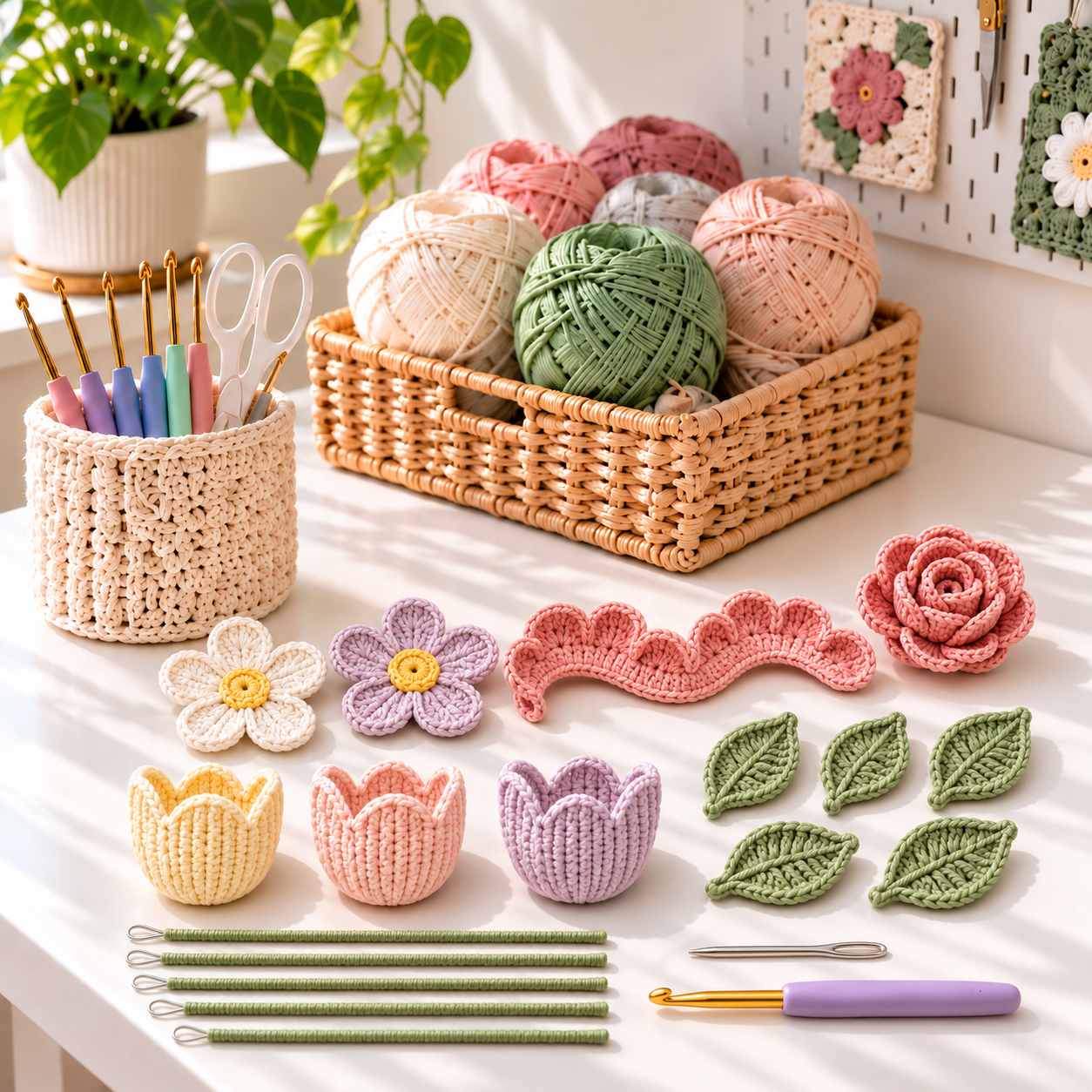
Easy Five-Petal Crochet Daisy
The daisy is the quickest design and works well as a main flower or small filler.
- With yellow yarn, make a magic ring and work 10 sc into it. Pull closed and join with a sl st.
- Change to cream or white. In the first stitch work: ch 2, 2 dc, ch 2, sl st.
- Slip stitch into the next stitch, then repeat the petal sequence in the following stitch.
- Continue around to make 5 petals, using two center stitches for each petal section.
- Fasten off with a long tail. Shape the petals with your fingers.
For a larger daisy, replace each pair of double crochet stitches with three treble crochet stitches. Lavender, peach, or pale blue petals create a playful wildflower effect.
Simple Rolled Crochet Rose
This rose begins as one ruffled strip, so there are no separate petals to sew together.
- Chain 41 in blush, coral, red, or cream.
- Starting in the second chain, sc across. (40)
- Chain 2 and turn. Work 3 dc in each stitch across. The strip will curl naturally.
- Fasten off, leaving a 50 cm tail for sewing.
- Roll the first end tightly to make the center. Continue wrapping the ruffled strip more loosely around it.
- Use the long tail to stitch through the flat bottom every few centimeters, securing all layers.
Roll the strip tightly for a rosebud or loosely for a full open rose. Two shades can be joined halfway along the strip for softly blended petals.
Cupped Crochet Tulip
The tulip is worked in continuous rounds. Mark the first stitch of every round.
- Round 1: Make 6 sc in a magic ring. (6)
- Round 2: Inc in each stitch. (12)
- Round 3: [Sc, inc] repeat around. (18)
- Rounds 4–8: Sc in every stitch. (18)
- Insert a small amount of fiberfill around the stem position. Do not overstuff.
- Flatten the upper opening slightly. Join the front and back edges with three evenly spaced slip stitches, leaving rounded sections between them to suggest tulip petals.
Fasten off and gently pull the three top points outward. Make tulips in lavender, yellow, coral, or soft pink to add height and a clean silhouette to the bouquet.
Quick Crochet Leaf
- Chain 12.
- Starting in the second chain, work: sl st, sc, hdc, dc in the next 5 chains, hdc, sc, sl st.
- Chain 2 at the tip and continue along the unused side of the foundation chain in reverse order.
- Join at the base and fasten off with a long tail.
Surface slip stitches along the center form a raised vein. Steam cotton leaves lightly if needed, but keep hot steam away from acrylic yarn.
Attach Flowers to Stems
Fold over the sharp end of floral wire with pliers so it cannot poke through the flower. For a daisy, pass the folded end behind the center and stitch it securely. For a rose, place the wire along the flat base before completing the final sewing stitches. Insert a wrapped stem into the stuffed tulip base and stitch tightly around it.
Wrap each stem with floral tape, stretching the tape slightly as you spiral downward. Alternatively, apply a thin line of glue and wrap the wire with green yarn. Sew one or two leaves near the upper third of the stem. Do not use exposed wire in projects intended for young children.
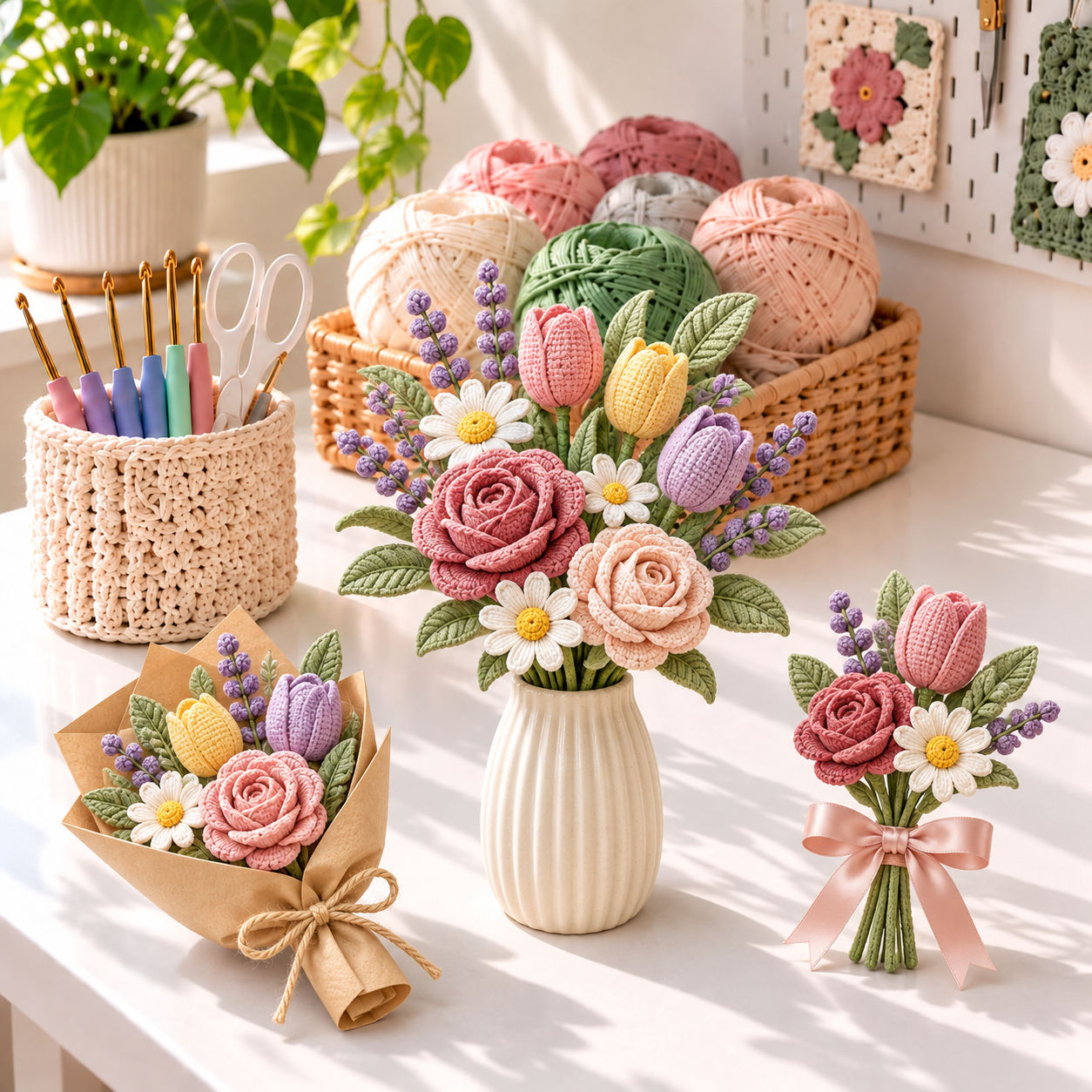
How to Arrange a Crochet Flower Bouquet
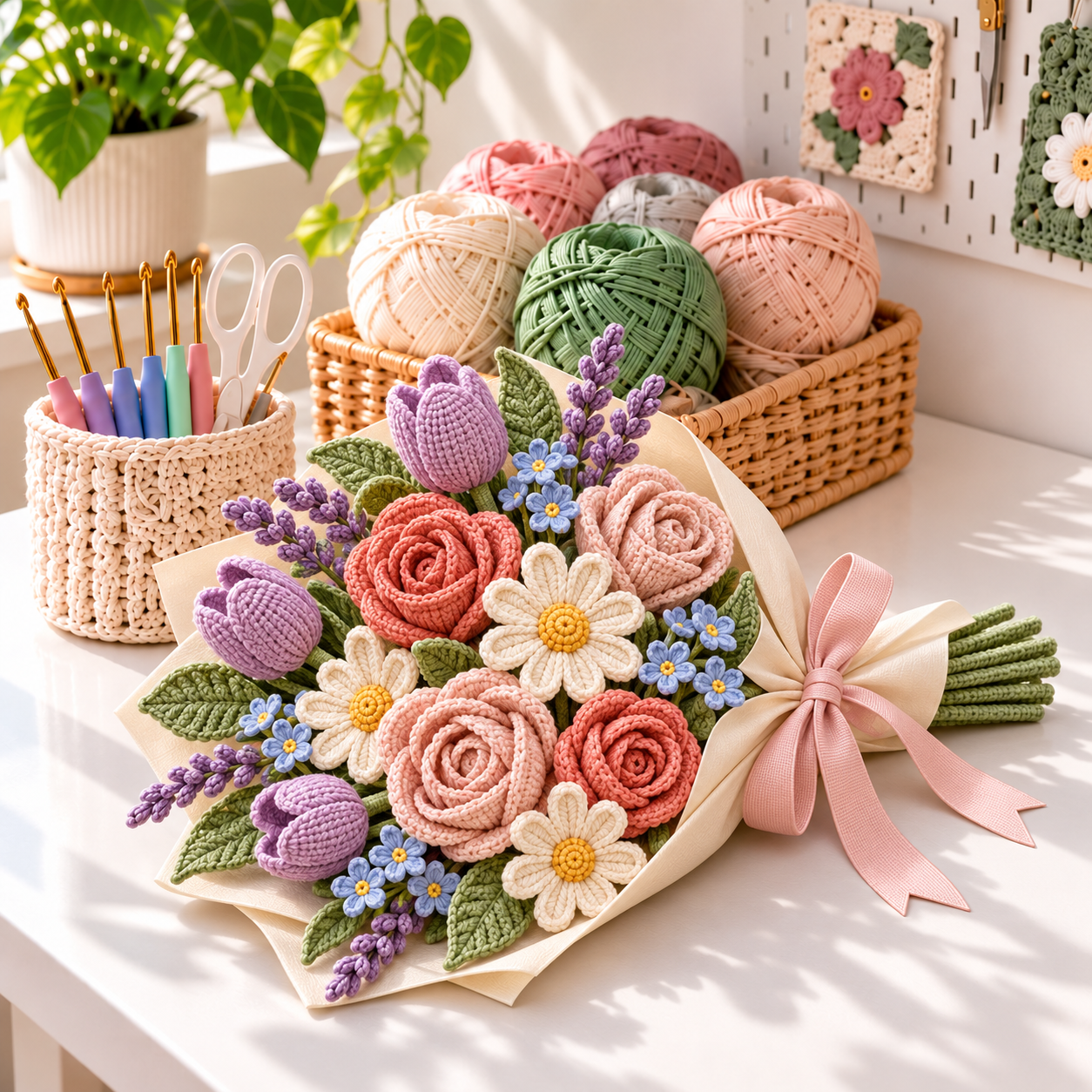
Begin with the tallest tulips and place them slightly off-center. Add roses at medium height, then fill the spaces with daisies, small blue flowers, or lavender sprigs. Rotate the bouquet as you work so it looks balanced from every side.
A pleasing medium bouquet can contain:
- 3 rolled roses
- 3 tulips
- 4 daisies
- 5 to 7 small filler sprigs
- 8 to 12 leaves
Hold the stems together and wrap them firmly with floral tape. Trim the ends to one length. Place the bouquet diagonally on two squares of kraft or cream paper, fold the sides inward, and tie with ribbon. For a vase arrangement, leave stems at different lengths and use floral foam or crumpled tissue inside the vase to hold their positions.
Three Easy Styling Ideas
Pastel Gift Bouquet
Combine blush roses, lavender tulips, cream daisies, and sage leaves. Wrap them in neutral paper with a pink ribbon for birthdays, Mother’s Day, or a thank-you gift.
Bright Table Arrangement
Use coral, yellow, purple, and white flowers in a cream vase. Repeat each color at least twice so the arrangement feels intentional rather than random.
Mini Three-Flower Posy
Choose one rose, one tulip, and one daisy. Add two leaves and a small filler sprig, then tie the stems with satin ribbon. This size is ideal for teacher gifts, party favors, and craft-market displays.
Finishing Tips
- Weave yarn tails toward the flower center where they remain hidden.
- Vary the stem lengths by 2–5 cm for a natural arrangement.
- Use odd numbers of the largest flowers when possible.
- Keep leaves around the outer edge to frame the colorful blooms.
- Dust finished flowers with a soft brush or cool hair dryer.
Frequently Asked Questions
How long does one crochet flower take?
A daisy may take 15–20 minutes, a rolled rose about 30 minutes, and a tulip 30–45 minutes. Assembly becomes faster after the first few stems.
Can I make flowers without wire?
Yes. Use wooden skewers with the pointed tips trimmed and covered, or crochet soft stuffed tubes for child-safe decorative flowers. Flat flowers can also be used as appliqués without stems.
What colors work best together?
Choose one main color, one nearby shade, and one contrasting accent. Add cream and green as neutrals. Blush, coral, lavender, cream, and sage form an easy balanced palette.
Once you learn these three patterns, Crochet! Flowers can become bouquets, wreath accents, gift toppers, hair accessories, or lasting home décor. Start with one simple daisy, build a few coordinating blooms, and enjoy arranging a garden made entirely from yarn.