
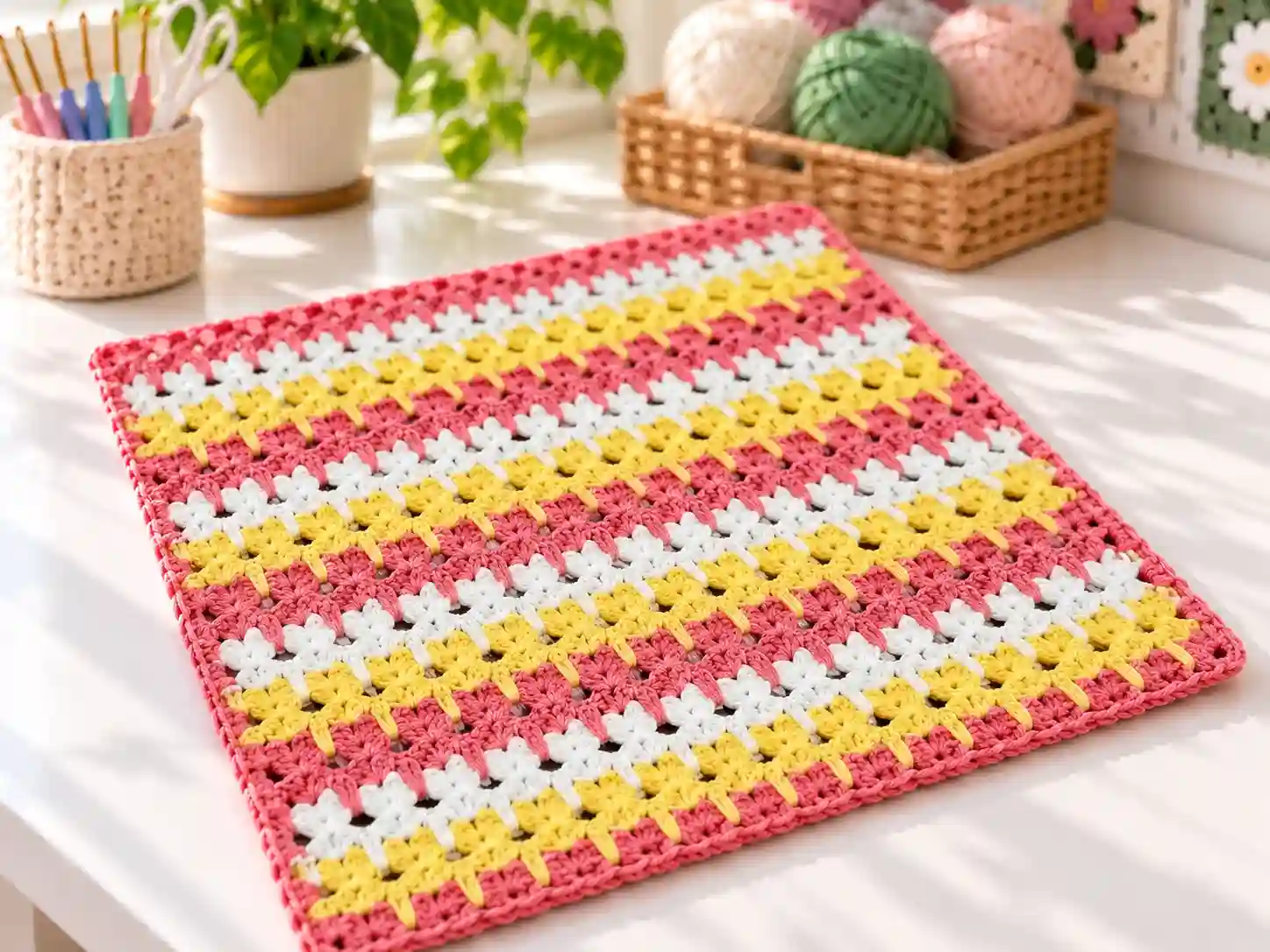
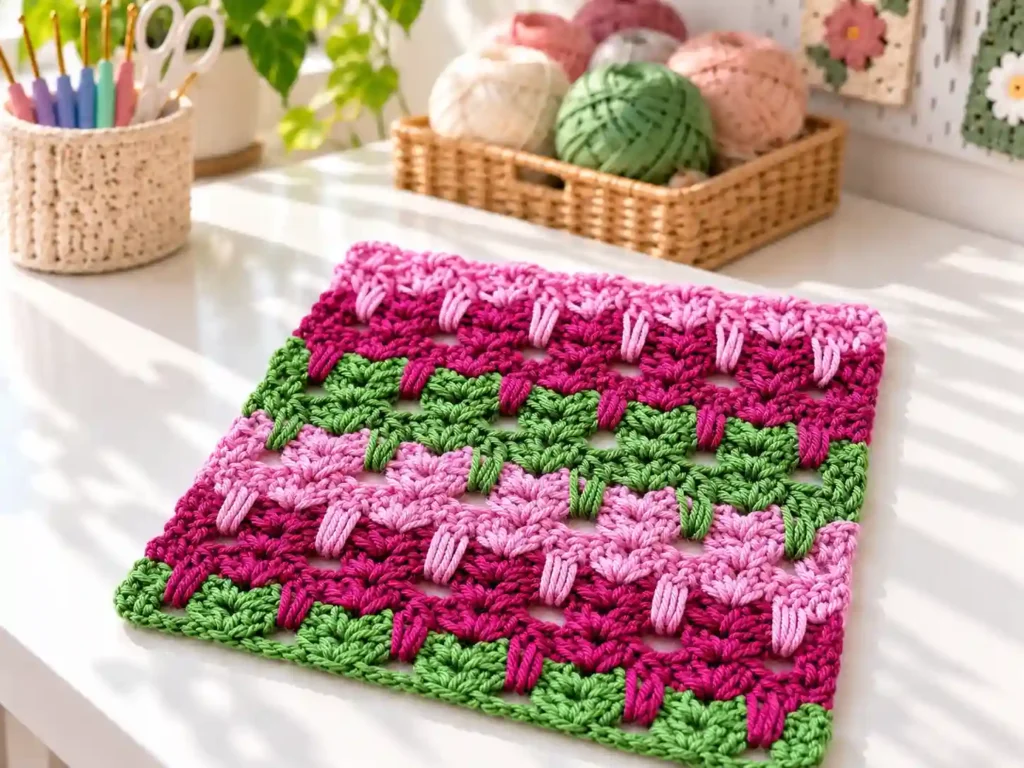
The crochet cat stitch creates a playful fabric covered in little cat faces, complete with pointed ears and tiny paw-like details. It looks much more complicated than it is: the design is built from double crochets, chains, shells, and tall clusters worked over a simple repeat. Use it for a blanket, scarf, cushion cover, or any project where you want texture with plenty of personality.
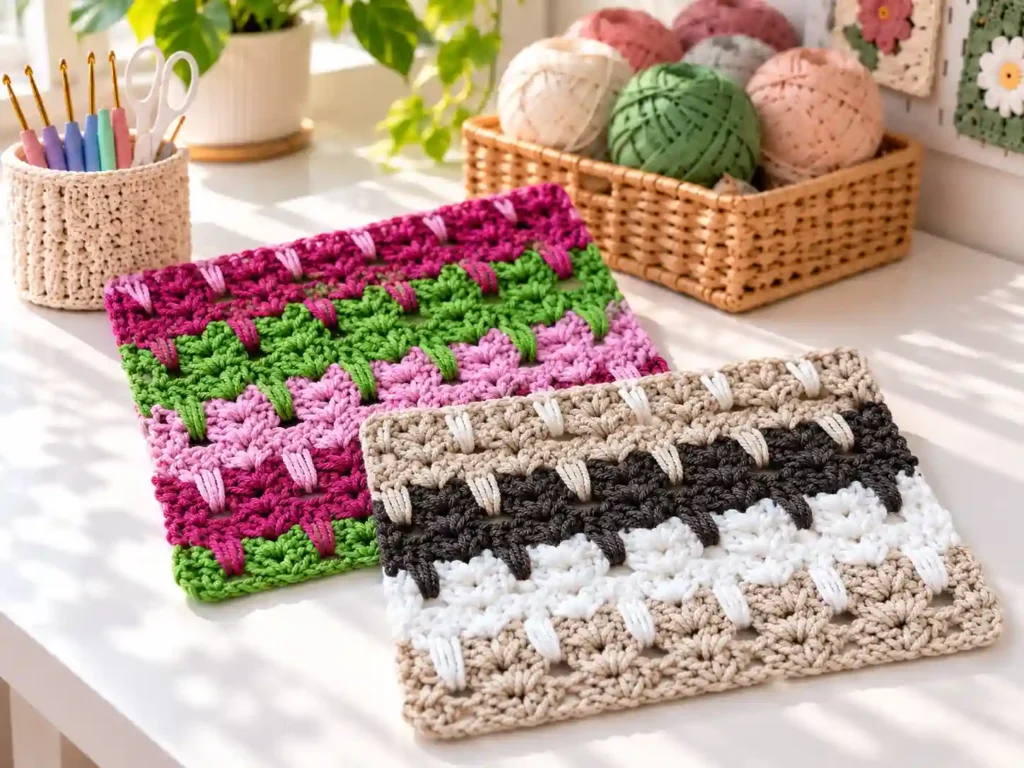
This written pattern uses US crochet terminology. The cat motif appears through a three-row repeat, so once you complete the first few rows, the rhythm becomes easy to follow. Change colors every few rows to make each cat stand out, or work the entire piece in one shade for a quieter, more textured look.
Why You’ll Love This Crochet Project
- The stitch repeat uses familiar basic crochet techniques.
- Cat shapes emerge naturally from the stitch structure, without appliqué or embroidery.
- It works beautifully for blankets, scarves, and decorative home pieces.
- Color changes create a cheerful striped effect without complicated colorwork.
- You can adjust the width by changing the starting chain in multiples of five plus one.
Finished Size
No finished measurements are provided with this stitch pattern. Your final size depends on your starting chain, yarn weight, hook size, and personal tension. For a blanket, continue repeating the stitch pattern until the piece reaches the length you want.
Materials You’ll Need
- Yarn in one or more colors
- Crochet hook suited to your yarn
- Scissors
- Tapestry needle
- Stitch markers, optional
Yarn Information
No specific yarn weight, fiber, or yardage was provided for this pattern. Choose a smooth, plied yarn with good stitch definition so the cat faces remain clear. Cotton, acrylic, or a cotton-acrylic blend are all practical choices for blankets and everyday projects.
A lighter yarn will produce a smaller, more delicate motif, while bulky yarn creates a bolder fabric with larger cats. Always match your hook to the yarn label and make a small swatch before starting a large project.
Crochet Hook
No hook size was specified. Use the hook size recommended on your yarn label, then adjust if your fabric feels too tight or too loose. A hook that gives you comfortable, even tension will make the tall cluster stitches much easier to work.
Crochet Abbreviations
This pattern uses US terminology.
- ch = chain
- dc = double crochet
- st = stitch
- sk = skip
- sp = space
- 2dccl = 2 double crochet cluster, also called dc2tog
- FO = fasten off
Pattern Notes
- The starting chain should be a multiple of 5 plus 1.
- The pattern is worked in rows and turned at the end of each row.
- At the beginning of Rows 2 through 4, chain 3 counts as one double crochet.
- The shell is made by working 2 dc, ch 1, 2 dc into the same chain or space.
- In Row 3, the 2dccl is worked into the space two rows below, which forms the cat’s face detail.
- Repeat Rows 2 through 4 until your project reaches the desired length.
- Fasten off after Row 2 if you plan to change colors before Row 3.
Crochet Cat Stitch Written Pattern
Make a slip knot and chain any multiple of 5 plus 1. For practice, 21 chains is a good starting length.
Row 1
Dc in the 4th ch from hook, dc in the next st, sk 2, (2 dc, ch 1, 2 dc) in the next ch, *sk 4, (2 dc, ch 1, 2 dc) in the next ch*; repeat from * across to the last 4 ch, sk 2, dc in the last 2 ch. Turn.
Row 2
Ch 3, dc in the next st, sk 2, (2 dc, ch 1, 2 dc) in the next sp, *sk 4, (2 dc, ch 1, 2 dc) in the next ch*; repeat from * across to the last 4 sts, sk 2, dc in the last 2 sts. Turn.
If changing colors, fasten off at the end of this row and join the new color to the first stitch before beginning Row 3.
Row 3
Ch 3, dc in the next st, 2dccl in the sp 2 rows below, *sk 2, (2 dc, ch 1, 2 dc) in the next sp, sk 2, 2dccl in the sp 2 rows below*; repeat from * across to the last 2 sts, dc in the last 2 sts. Turn.
Row 4
Ch 3, dc in the next st, sk 3, (2 dc, ch 1, 2 dc) in the next ch, *sk 5, (2 dc, ch 1, 2 dc) in the next ch*; repeat from * across to the last 3 sts, sk 3, dc in the last 2 sts. Turn.
Repeat Rows 2 through 4 until your piece is as long as you like. To make a striped cat crochet blanket, change colors after Row 2, work Row 3 in the new shade, then continue with Rows 2 through 4 before changing again.
Finishing Touches
Fasten off, leaving a long yarn tail if you plan to sew the piece to another project. Weave in every end securely with a tapestry needle, following the direction of the stitches so the tails stay hidden. For a blanket, lightly block the finished piece if the edges look uneven; pin it to shape, mist or wet block according to your yarn’s care guidance, and allow it to dry completely.
Crochet Tips
- Keep the beginning chain loose. A tight foundation chain can make Row 1 difficult to work.
- Count your shells at the end of Rows 1 and 2 before moving on.
- Draw the loop for each 2dccl up smoothly in Row 3; pulling too tightly can shorten the cat-face detail.
- Use a stitch marker at the first and last stitch of each row if your edges tend to wander.
- Change colors at the end of Row 2 for the cleanest transition between stripes.
- Make a small practice swatch before committing to a full blanket.
Variations
- Work in a single color for a subtle, textured fabric.
- Change colors every three rows to give each cat face its own background.
- Use a variegated yarn for a quick, colorful effect with no extra ends to weave in.
- Make a narrow scarf by starting with a smaller multiple of 5 plus 1.
- Use the stitch as a panel for a cushion cover, bag front, or baby blanket.
Common Problems and Troubleshooting
The cat faces are not showing clearly
Check that the 2dccl in Row 3 is placed in the space two rows below, not in the current row. A fuzzy yarn can also hide the detail, so choose a smooth yarn for your first swatch.
The edges are uneven
Make sure the turning chain is counted correctly and that you are not skipping or adding a stitch at the row ends. Mark the final stitch of each row until the repeat feels automatic.
The fabric is curling
Curling often comes from tight tension or a hook that is too small for the yarn. Try a larger hook, relax your grip, and block the finished swatch gently.
The width is wrong
The starting chain must be a multiple of 5 plus 1. If your repeat does not line up, count the foundation chain again before working Row 1.
How to Use the Finished Crochet Project
- Make a cozy throw or baby blanket.
- Crochet a scarf with repeating cat motifs.
- Use a panel as the front of a cushion cover.
- Create a small wall hanging for a nursery or craft room.
- Turn a narrow strip into a table runner or bag accent.
Care Instructions
Follow the care instructions on your yarn label. For most acrylic or cotton blankets, wash gently in cool water and dry flat to preserve the shape. Avoid wringing the fabric, and reshape it while damp if needed.
Frequently Asked Questions
Is the crochet cat stitch suitable for beginners?
Yes. It uses double crochet, chains, shells, and a simple cluster. The main challenge is keeping track of the repeat, so work slowly through the first few rows.
What yarn works best for the cat stitch?
A smooth worsted-weight cotton, acrylic, or cotton-blend yarn is a dependable choice because it shows the cat shapes clearly.
Can I use a different hook size?
Yes. Choose a hook that suits your yarn and gives you a fabric you like. A larger hook creates a looser, more open fabric.
How do I make the project wider?
Add or remove chains in multiples of 5, always keeping the final chain count as a multiple of 5 plus 1.
Can I make a cat crochet blanket with this stitch?
Absolutely. Continue repeating Rows 2 through 4 until the blanket reaches your preferred length, changing colors as often as you like.
Why does my Row 3 look different from the photos?
Row 3 introduces the tall cluster worked two rows below. If it is worked into the current row instead, the cat-face texture will not form correctly.
How should I wash a cat stitch blanket?
Use the yarn label as your guide. In general, wash gently, avoid high heat, and dry flat to keep the motif crisp.
Conclusion
The crochet cat stitch is a satisfying way to turn basic stitches into a fabric full of charm. Try it in soft pastels for a baby blanket, bold stripes for a playful throw, or a single neutral shade for a textured scarf. Once the repeat clicks, you may find yourself planning an entire cat-themed crochet collection.